Moving from France to Dubai is one of the most financially significant decisions an entrepreneur can make. The UAE offers 0% personal income tax, 0% capital gains tax, and access to one of the most business-friendly corporate environments in the world.
But leaving France is not just about arriving somewhere new. It’s about severing a tax relationship that France takes seriously — and doing it correctly, so you don’t end up as a double taxation France UAE expat.
This guide covers exactly what you need to know. How double taxation France UAE expat situations arise. What the treaty protects. What it doesn’t. How to properly establish Dubai tax residency as a French entrepreneur. And what to do about exit tax before you go.
Why Double Taxation France UAE Expat Risk Is Real
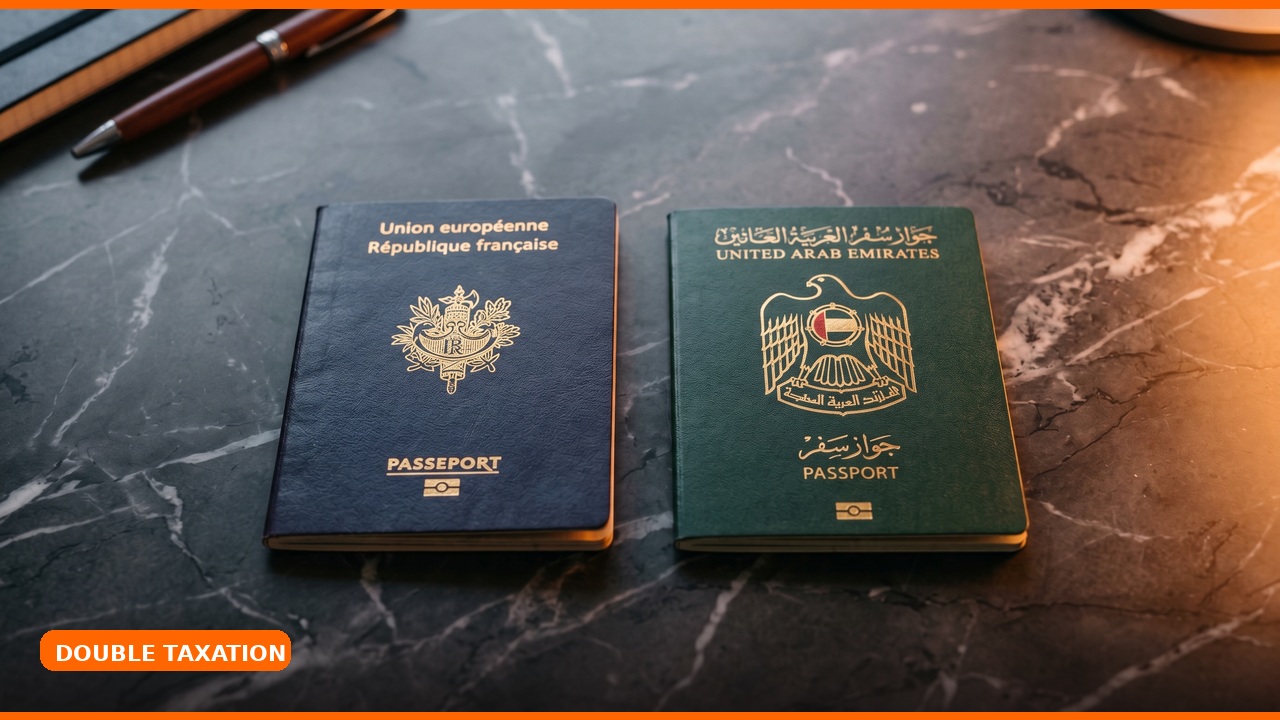
France taxes its residents on worldwide income. The moment you leave, France doesn’t automatically let go. If you don’t properly break your French tax residency, you remain a French tax resident — and France will tax your income regardless of where you earn it.
The double taxation France UAE expat scenario looks like this: you’re physically in Dubai, running a business, paying no personal income tax there — but France considers you still a resident and expects you to declare and pay French income tax on everything you earn globally.
That’s not a theoretical risk. The French tax administration actively investigates high-income individuals who relocate to zero-tax jurisdictions. UAE-based French entrepreneurs are on their radar.
The good news: France and the UAE have a double taxation treaty in place since 1989. It defines clear rules about who has the right to tax what — and it’s your primary legal tool for avoiding any double taxation France UAE expat liability.
What the France UAE Tax Treaty Actually Does
The France UAE tax treaty is a bilateral agreement that prevents the same income from being taxed twice. It’s the legal backbone that every double taxation France UAE expat relies on. It determines which country has the right to tax each type of income, and under what conditions.
For a French entrepreneur who has properly relocated to Dubai, the treaty works like this:
Employment and business income: Once you are a genuine UAE tax resident, income from your business activity in Dubai is generally exempt from French tax. France gives up its right to tax it.
Dividends: Dividends from French companies paid to UAE residents benefit from a reduced withholding tax — 0% if you hold at least 10% of the company’s capital for 12 months, 5% in other cases. Without the treaty, French withholding rates on dividends are higher.
Capital gains: Gains from the disposal of non-real estate assets are generally taxed in the country of residence. If you’re a UAE tax resident when you sell, France loses its right to tax those gains.
Real estate income: The key exception. French rental income is taxable in France regardless of where you live. Moving to Dubai doesn’t change this.
The critical condition: you must be a genuine UAE tax resident. The France UAE tax treaty only protects you if the UAE — not France — is your actual country of residence for tax purposes. Every double taxation France UAE expat protection in the treaty hinges on this.
How to Break French Tax Residency — The Right Way
This is where most entrepreneurs create their double taxation France UAE expat exposure. They move to Dubai physically but fail to properly sever their French tax residency. Then they’re surprised when the French tax administration sends them a bill.
France considers you a tax resident if any one of these applies:
- Your permanent home (foyer) is in France
- Your center of vital interests is in France (family, main economic activity)
- You spend more than 183 days per year in France
- Your primary professional activity is based in France
You need to break all of these links — not just one. As a double taxation France UAE expat, you carry the burden of proving you’re no longer a French resident.
To genuinely establish Dubai tax residency as a French entrepreneur and eliminate double taxation France UAE expat risk, you need to:
Move your foyer. Your main home must be in Dubai. Renting or purchasing property in Dubai establishes this. Keeping a home available to you in France — even if it’s technically a family member’s — keeps a link the French tax authorities can use.
Move your center of vital interests. Where is your business activity? Where does your family live? Where are your main banking relationships? All of these should shift to the UAE.
Spend enough time in Dubai. There’s no hard UAE rule requiring 183 days, but practically speaking, you should be spending the majority of your year in the UAE. Spending more than 183 days in France in any given year reestablishes French residency immediately.
Close or restructure French economic ties. Directors’ positions in French companies, active partnerships, significant ongoing business in France — these signal to the French tax administration that your center of economic interest remains in France.
Important: your departure must be formally declared to the French tax administration. File a declaration of departure — your final French tax return as a resident — to officially close the French tax residency relationship. Failing to do this is the most common double taxation France UAE expat trap.
The Exit Tax: What It Is and What It Means for You

Before you leave, you need to know about France’s exit tax (impôt de sortie).
The exit tax applies to unrealized capital gains on shares, securities, and company interests when you transfer your tax domicile outside France. It’s designed to capture the increase in value of assets you’ve built up while you were a French resident — value that France would have taxed if you’d sold before leaving.
Who it applies to: You must meet both conditions.
1. You have been a French tax resident for at least six of the last ten years before departure.
2. You hold shares or securities worth more than €800,000, or you own at least 50% of a company’s share capital.
If both conditions apply, you owe exit tax on your unrealized gains at the date of departure. The rate is 30% (12.8% income tax + 17.2% social contributions) on the gain.
The automatic deferral. Because you’re moving to the UAE — a non-EU country with a tax treaty — exit tax payment is automatically deferred. You don’t pay it immediately. But you do have to file an annual declaration (Form 2074-ETS) confirming you still own the assets. Every year.
When the exit tax disappears. After a period of time, the exit tax liability is definitively waived:
- If the assets are worth under €2,570,000 at departure: 2 years
- In all other cases: 5 years
This means that for most French entrepreneurs relocating to Dubai, the exit tax is a declaratory obligation — not an immediate cash payment — as long as they hold the assets and remain outside France.
The smart move: If you’re planning to sell shares or exit a business, do it after you’ve been a UAE resident long enough that the exit tax has lapsed. This is a structuring decision, not an accounting one, and it needs to be made before you leave.
How to Get Your UAE Tax Residency Certificate
The UAE Tax Residency Certificate (TRC) is your official proof that the UAE recognizes you as a tax resident. It’s issued by the Federal Tax Authority (FTA) and is the document you’ll use when claiming treaty protection against double taxation France UAE expat challenges from the French administration.
Eligibility. As a French entrepreneur in Dubai, you qualify under one of three routes:
- 183-day rule: You’ve spent at least 183 days in the UAE in the relevant 12-month period.
- 90-day rule: At least 90 days in the UAE, plus you hold a UAE residence visa, own or rent property in the UAE, or have an active business.
- Centre of vital interests: The UAE is demonstrably your primary home and the center of your financial and personal life.
Documents required:
- Valid passport
- UAE residence visa (issued at least 180 days before application)
- Emirates ID
- Ejari-registered tenancy contract or property title deed
- UAE entry/exit report from ICP showing days in the UAE
- UAE trade licence or proof of business activity
- Any French tax forms requesting confirmation of UAE residency
Application process. Everything is done online via the FTA’s EmaraTax portal. The process takes 4–7 business days. The TRC is valid for one year and must be renewed annually.
Do not wait for a dispute before applying. Get the TRC as soon as you’re eligible. It’s your proof file — every double taxation France UAE expat who doesn’t have one is fighting a challenge unarmed. Build the evidence before you need it.
The Income Types That Are Still Taxable in France After You Leave
The France UAE tax treaty protects a great deal — but not everything. As a Dubai tax residency French entrepreneur, you need to know what France retains the right to tax:
French rental income. Income from property you own in France is taxable in France. Period. Moving to Dubai doesn’t change this.
French-source dividends above the treaty threshold. If you receive dividends from French companies where you hold less than 10%, France applies a 5% withholding tax under the France UAE tax treaty.
French pension income. Government pensions paid by France remain taxable in France under the treaty.
French capital gains on real estate. If you sell a property in France, France taxes the gain. The UAE residency doesn’t shield this.
For everything else — business income, investment income, dividends from your UAE company, capital gains on non-French securities — proper UAE tax residency and the France UAE tax treaty should fully protect you.
The Most Common Mistakes French Entrepreneurs Make
Based on the patterns we see, here are the situations that create double taxation France UAE expat exposure:
Not formally declaring departure. Moving without filing the departure declaration leaves your French tax residency technically open. France has a 10-year statute of limitations on undeclared income. Every double taxation France UAE expat dispute we’ve seen starts here.
Keeping a home available in France. Even if you don’t live there, a property available for your use is enough for France to maintain residency claims. Rent it out formally or sell it.
Spending too much time in France. Business trips, family visits, holidays — they add up. Track your days. Crossing 183 in France in any tax year reestablishes residency immediately.
Selling shares too soon. Exiting a French business before the exit tax deferral period has expired crystallizes the liability.
Not getting the TRC. Without a UAE Tax Residency Certificate, you have no official proof of UAE residency when the French administration challenges your double taxation France UAE expat status.
What a Proper Departure Structure Looks Like
The ideal approach for a French entrepreneur relocating to Dubai is not just a move — it’s a structured exit.
12–18 months before departure: review your asset holdings. If you have shares in French companies, assess whether restructuring them before departure reduces your exit tax exposure. This is a complex calculation that requires a French tax specialist.
At departure: file your final French tax return as a resident. Declare your departure date. Notify your bank, accountant, and any French entities of your change of status.
Within the first 6 months in Dubai: apply for your UAE tax residency certificate as soon as you meet the eligibility threshold. Set up your company structure properly so your income flows through the right entity.
Annually: renew your TRC. File the exit tax deferral declaration (Form 2074-ETS) if applicable. Keep records of your UAE presence.
This is the difference between a double taxation France UAE expat problem and a clean, fully-protected relocation.
If you are a French entrepreneur planning to relocate to Dubai, getting the structure right from the start is not optional — it is the difference between a clean exit and years of unnecessary exposure.
At GCG Structuring, we work with founders navigating exactly this transition. We help you understand where your risk sits, structure your UAE company properly, and ensure your departure from France is clean, compliant, and built to last.