A founder owns an operating business, property and investment accounts. The children should benefit from the wealth, but only one wants to run the business. The family needs to decide who owns the assets, who makes decisions and who coordinates the work. This is a hypothetical example.
Choosing between a DIFC Foundation, a UAE holding company and a family office starts with those questions. You may need one, a combination, or none.
In short:
A DIFC Foundation can provide a governance and ownership framework for family assets. A UAE holding company can own shares and permitted assets. A family office coordinates reporting, advisers and administration. Some families use more than one, but each layer should solve a specific problem.
| question | difc foundation | UAE holding company | Family office |
|---|---|---|---|
| What is it? | A separate legal person established under DIFC Foundations Law | A company used to hold shares or other permitted assets | A function or organisation that coordinates family affairs |
| Who owns its assets? | The foundation owns assets transferred to it; it has no shareholders | The company owns its assets; shareholders own shares in the company | Ownership depends on the entities and accounts used; the office need not own family assets |
| Who makes decisions? | The council acts under the charter, by-laws and applicable law | Directors or managers act within company documents and shareholder rights | The family and appointed team act within clear responsibilities |
| How does it relate to succession? | It can provide continuity of ownership and rules for benefits and governance | It can organise ownership, but succession to personally held shares still needs planning | It can administer a succession plan, but does not create the legal transfer mechanism by itself |
| What ongoing work remains? | Governance, records and applicable compliance | Corporate administration, accounts and applicable compliance | Coordination, reporting and oversight of the agreed functions |
| Best suited to | Governance, continuity and family benefits | Centralised ownership of companies and permitted assets | Coordinating advisers, records and ongoing decisions |
1. Why families often compare the wrong structures
The question “foundation, holding company or family office?” combines legal vehicles with a service and governance model.
You might need a parent company to own several business shareholdings. You might want future generations to receive benefits without dividing control. Or you might need someone to reconcile reports from banks and advisers who each see only part of the family's affairs.
Start with the problem. Our Private Client Structuring work examines ownership and control across the family's assets before selecting a structure.
2. What a DIFC Foundation is designed to do

A DIFC Foundation has legal personality separate from its founder and council members. It owns assets in its own name and has no shareholders. The founder establishes its purposes and governance through a charter and by-laws, within the limits of DIFC law.
For a family, that can provide a continuing owner for business shares or other assets that the foundation can lawfully receive. Family members may benefit under the governing documents without each receiving a shareholding in the foundation itself.
The distinction matters when a family wants to separate economic benefit from day-to-day control. In the founder example, the children might receive distributions under agreed rules while appointed people oversee the business shareholding. The documents must define those rights; the family cannot rely on the word “foundation” to establish them.
Ownership continuity requires completed transfers
If the founder still owns an asset personally, incorporating a foundation does not change that ownership. The transfer requires the relevant documents, registrations and consents. A lender, shareholder agreement or property registry may impose conditions.
An asset validly transferred to the foundation belongs to that legal person rather than to the founder. This can support continuity when the founder dies. Personal assets outside the foundation still need separate succession planning. Foreign recognition and the law governing each asset also need review.
Governance needs to work without the founder
A council administers the foundation under its governing documents. Guardian requirements and any powers the founder reserves need legal review for the proposed arrangement.
Define who appoints replacement council members, how decisions receive approval and who can act during incapacity. If the founder controls each important decision without a workable replacement mechanism, the family may face a governance gap despite having incorporated a foundation.
Legal separation does not promise immunity from creditors, divorce proceedings or challenges to transfers. Timing, purpose, retained powers and applicable law matter. A DIFC Foundation may conduct only commercial activities necessary for, and ancillary or incidental to, its objects. Review active business operations separately and use a suitable licensed company where required.
Read more about the ownership and governance framework on our DIFC Foundation page.
3. What a UAE holding company is designed to do
A UAE holding company can own shares in businesses and other permitted assets. “Holding company” describes its role; the legal form, jurisdiction and licence determine what it can do.
A founder can place several business shareholdings under a parent company. Subsidiaries conduct their respective activities. Directors or managers oversee the holding company, while shareholders exercise the rights attached to their shares.
The family can use that ownership layer to organise investments, introduce another shareholder or prepare for a sale. Shareholder documents must address approvals, transfer restrictions and disagreements.
A passive holding vehicle should not trade, provide advisory services or manage investments unless its permissions allow those activities. Property and investment ownership also depend on the relevant rules.
Share ownership still needs a succession plan
A holding company continues to own its assets when a shareholder dies. The deceased shareholder's shares and associated authority may require estate administration.
In the founder example, grouping investments could simplify the ownership map. If the founder owns the holding-company shares personally, the family still needs to plan who inherits them and who acts during estate administration.
A foundation may hold those shares. Another family's needs may call for a will or a different arrangement.
Separate companies require separate conduct
Keep each entity's accounts, contracts and decision records consistent with its role. Review guarantees, security and intercompany transactions: they can expose more than one entity to a claim.
Our UAE Holding Company Setup guide explains formation. Assess the assets and permitted activities before choosing a vehicle.
4. What a family office is designed to do
A family office coordinates reporting, governance meetings and external advisers. The family should give its team clear responsibilities and approval limits.
A family may employ a dedicated team or use external specialists for selected functions. An entity providing those services need not own the family's business shares, property or investment accounts.
An accountant may hold one set of figures while bankers hold account statements and lawyers hold succession documents that predate an acquisition. A family-office team brings those records together and assigns follow-up responsibilities.
The team can maintain an asset register and compliance calendar, prepare information for the council or directors, and follow up on approved decisions. It must know who can approve payments and ownership changes.
Services and licensing must match
Single-family arrangements and businesses serving unrelated families can face different regulatory requirements. DIFC has a specific family-office framework, but the label provides no general exemption from financial-services regulation.
Investment management, financial advice and arranging transactions can require authorisation. Assess the actual activities and jurisdiction before assigning them to the team.
GCG structures and administers the agreed framework and coordinates advisers. We do not manage client money or recommend investments. External managers remain responsible for investment services under their mandates and applicable permissions.
Our Family Office page explains this coordinating role.
5. When structures can work together
A family can combine these arrangements when each addresses a specific need. For the founder in our hypothetical example:
- A DIFC Foundation holds shares in a suitable UAE holding company under its governance documents.
- The holding company owns permitted business shareholdings, asset-holding subsidiaries or investments.
- The family-office team coordinates records, reporting and advisers alongside the ownership structure.
The foundation council oversees the foundation's shareholder decisions. Holding-company directors exercise their own authority. Operating-company management runs the business. The family-office team prepares reports and follows up on approved actions; it does not replace these governing bodies.
This illustration is not a recommendation for every family. A foundation may hold permitted assets without an intermediate company. A family with one business may need shareholder and succession documents before another entity. External administrators may provide enough support without a dedicated office.
Add a layer only after defining its purpose, annual workload and filing obligations. Test whether a simpler arrangement meets the need.
Ownership and governance, with separate support
An illustrative arrangement, not a recommendation or tax conclusion.
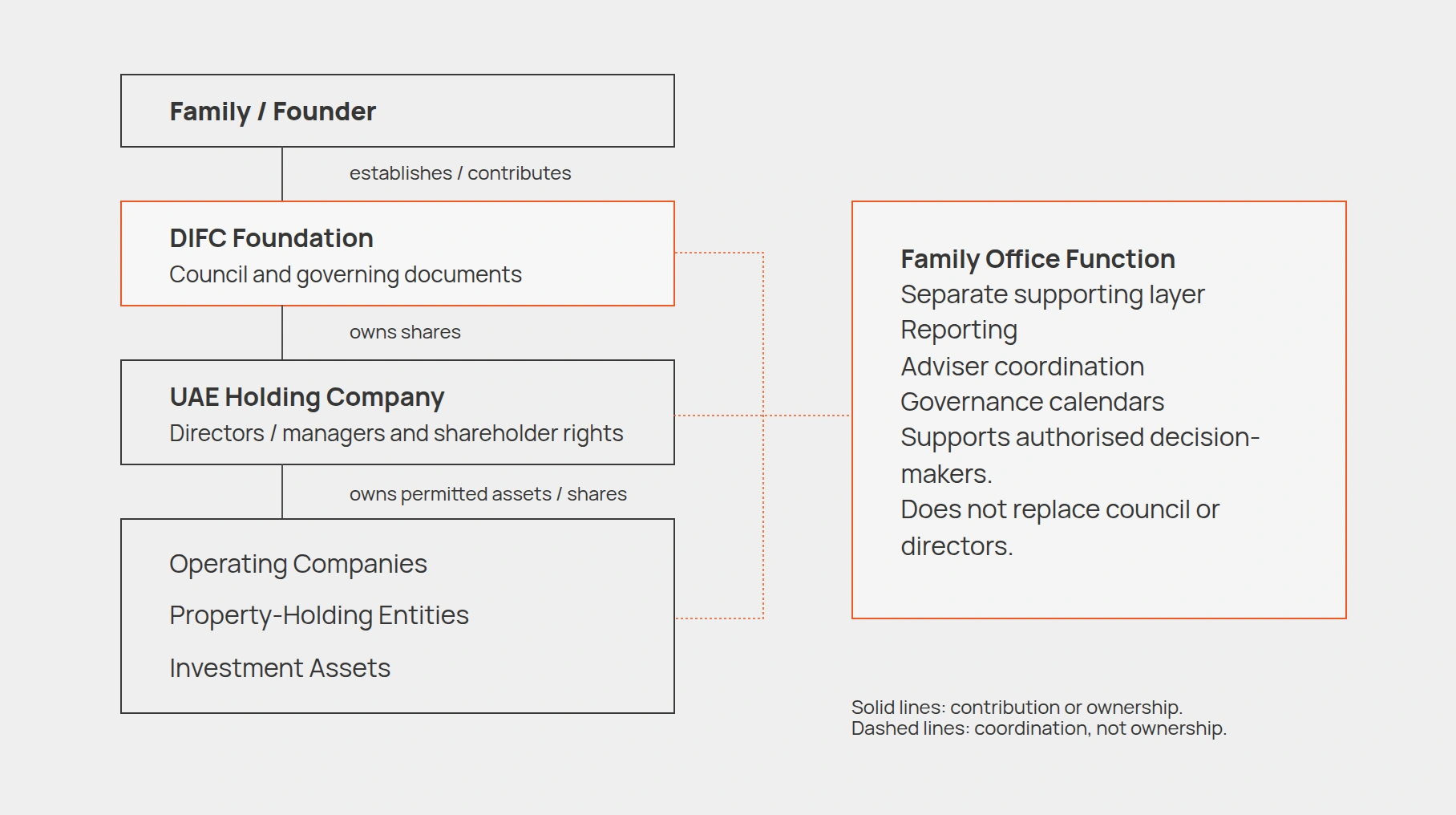
Illustrative arrangement only. Arrows show the founder's establishment or contribution role and potential ownership links, not automatic transfers or tax treatment. The family-office function supports authorised decision-makers; it does not own or control these layers by default.
6. Key questions before selecting a structure
Establish the facts that affect ownership, authority and implementation.
What do you own, and where?
Prepare an asset register showing the current legal owner, location and relevant contracts. Include liabilities, guarantees and restrictions on transfers. Different assets can require different treatment.
Who should control decisions and receive benefits?
Identify which decisions the founder wants to retain and which other people should make. Distinguish the right to receive money from the right to control a company. Agree how the family will resolve conflicts between those interests.
What happens during incapacity or death?
Test who can approve urgent payments, appoint replacement decision-makers and exercise shareholder rights. Compare that answer with the existing wills and succession documents. Our Succession work addresses continuity across these arrangements.
Where are the relevant people tax resident?
Review the founder, beneficiaries and decision-makers, including expected relocations. A UAE structure can have consequences in another country even when it has no tax liability on a particular receipt in the UAE.
Who will administer the arrangement?
Name the person responsible for accounting, renewals, compliance records and adviser coordination. Assess the annual workload and budget. Select an arrangement the family can maintain.
Can the assets move into it?
Check registry eligibility, financing terms, contractual consents and transfer costs before incorporation. Discuss the proposed arrangement with the relevant bank or custodian.
7. Important tax, banking, reporting and legal considerations
Tax and compliance depend on each entity's legal form, activities and circumstances. A DIFC address or family-office label does not determine the outcome.

UAE corporate tax
A UAE holding company receives no blanket corporate tax exemption for holding investments. Dividend and gain treatment depends on the applicable provisions and conditions. Free-zone treatment requires a separate assessment of the entity and its income.
Eligible family foundations can apply to the Federal Tax Authority for treatment as an Unincorporated Partnership for corporate tax purposes. Incorporation alone does not provide tax transparency. This tax treatment does not change a DIFC Foundation's separate legal personality.
A juridical person that is wholly owned and controlled by one or more qualifying Family Foundations may also apply for treatment as an Unincorporated Partnership, provided it meets the applicable conditions. In a multi-tier structure, each entity must be assessed separately, and the required tax-transparent ownership chain must remain intact.
The relevant Family Foundations must themselves have tax-transparent treatment. Each underlying entity must meet the conditions and obtain FTA approval where required. Beneficiaries must assess their own tax position. See section 6, including Example 9, and section 8.2.2 of the FTA's June 2026 Taxation of Family Foundations guide.
Cross-border tax and succession
Coordinate the foundation documents, wills and other succession arrangements with advisers in the countries connected to the assets and relevant people. They must assess foreign recognition, inheritance, taxation of transfers and distributions, and foreign-entity reporting obligations.
Banking and source-of-wealth evidence
Banks and custodians apply their own policies and legal duties. They may require an ownership chart, constitutional documents, details of relevant people, and evidence of source of wealth and funds.
A foundation's lack of shareholders does not remove identification and disclosure requirements. A family-office team can coordinate records and enquiries, but cannot guarantee account opening or transaction acceptance.
Reporting and ongoing records
Assess corporate tax registration, accounting, audit and ownership disclosures for each entity. Check Common Reporting Standard and FATCA classifications and reporting duties.
Maintain decision and transaction records. Review the position when the family acquires an asset, changes advisers or moves country.
Legal limits on protection
Apply the transfer, creditor and governance limits described in section 2 to the whole arrangement. Review existing liabilities and transfer restrictions before moving assets.

8. How GCG approaches purpose-led structuring
GCG begins with the family's assets, current owners and intended decisions. We identify the ownership, governance or administration gaps that need attention.
For the founder in our example, the first question is how to preserve business decision-making while defining benefits for both children. If succession documents and shareholder arrangements meet that need, another ownership entity may add unnecessary administration. If the family needs a continuing legal owner and documented benefit rules, we can assess a foundation. If ownership already works but nobody maintains consolidated records, the priority may be a family-office function.
GCG compares the options and coordinates the relevant legal and tax assessment. We define responsibilities and organise the transfers and administration within the agreed engagement scope. GCG is a corporate services firm; our role covers structuring, governance and administration, with specialist adviser coordination.
Before selecting a DIFC Foundation, holding company or family-office arrangement, prepare an ownership map, asset register, existing succession documents and a list of the jurisdictions connected to the family and its assets. GCG can assess where the current structure creates gaps in ownership, governance or administration.
The first conversation establishes whether GCG can help. Any assessment, deliverables and implementation work follow an agreed engagement scope.
This article provides general information. The appropriate structure and its legal and tax treatment depend on your circumstances and require individual assessment.